Stencil Handwritten Font for Crafters & Sellers
If you’ve ever spent ten minutes tweaking letter spacing on a candle label—only to realize the script font you chose looks lovely on screen but cuts poorly on your Cricut—then you know how much the right handwritten font impacts real-world product success. That’s why Stencil has become my go-to display font for physical and digital craft projects that need elegance *and* reliability.
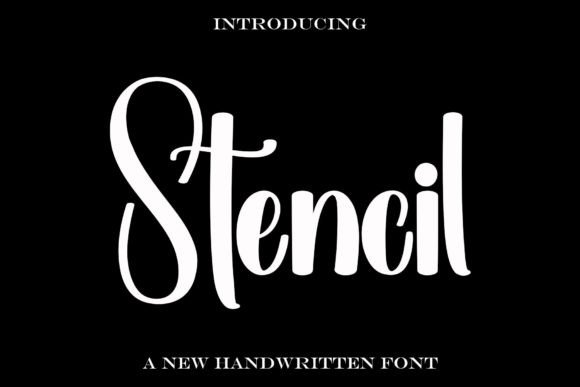
Stencil isn’t just another delicate script. It’s a neat and beautiful handwritten font with an elegant, controlled touch—think confident penmanship rather than rushed cursive. Its strokes flow smoothly but never collapse into illegibility, even at small sizes. There’s a quiet confidence in its curves: subtle contrast between thick and thin lines, balanced letterforms, and just enough personality to feel handmade without sacrificing polish. It reads as timeless—not trendy—and that makes it ideal for products meant to last beyond a single season.
Where Stencil Shines in Your Physical Products
I use Stencil across nearly every category in my shop: boutique labels, printable wall art, wedding welcome boards, seasonal packaging, and SVG-based iron-on designs. Here’s where it delivers the most value:
- Candle & soap labels: At 10–12pt, Stencil remains crisp when printed on kraft tags or cut from vinyl. Its clean entry and exit strokes prevent “blobbing” on small caps or tight curves—critical for 1.5" round stickers.
- Wedding stationery: From “Mr. & Mrs.” on foil-pressed invitations to hand-lettered seating charts, Stencil adds warmth without competing with calligraphy. It pairs beautifully with serif body fonts like Playfair Display for hierarchy and readability.
- Farmhouse-style signs & wall art: Whether laser-cut wood or printed canvas, Stencil’s balanced proportions hold up at large scale. I’ve used it for “Gather” above kitchen shelves and “Hello, Sunshine” on nursery prints—always legible, never fussy.
- Product packaging & boutique tags: For small-batch skincare or gourmet goods, Stencil lends artisanal credibility. On matte-finish hang tags, it signals care and intention—customers notice that difference before they even read the description.
- Mugs, totes & apparel: When converted to vector paths (using the included OTF files), Stencil holds detail cleanly for screen printing and heat transfer. No jagged edges, no lost terminals—even on curved surfaces like ceramic mugs.
Practical Tips for Cutting, Printing & Pairing
Stencil is designed for function, not just flair. It includes standard OpenType features—ligatures for common letter pairs (like “fi”, “fl”, “th”), contextual alternates for natural variation, and a full set of uppercase, lowercase, numerals, and punctuation. While it doesn’t include swashes or decorative flourishes, that’s intentional: this is a workhorse script font, built for clarity first.
For Cricut and Silhouette users: always convert Stencil to outlines before cutting intricate phrases. Its consistent stroke weight and open counters mean clean cuts down to 6mm height—perfect for mini gift tags or jar labels. On printed cards or invitations, avoid setting full paragraphs in Stencil; reserve it for headlines, names, and short phrases (3–7 words max). Use it as a display font, not body text.
Font pairing is where Stencil truly elevates your brand identity. I consistently pair it with a clean sans serif—like Montserrat or Poppins—for contrast and balance. For example: Stencil for “Wildflower Co.” on a lavender sachet label, Montserrat Light for “Hand-poured • Small Batch • Made in Oregon”. That combo says “crafted with care” while keeping information instantly scannable. If your brand leans more classic, try pairing Stencil with a gentle serif like Lora or Cormorant Garamond—ideal for wedding suites or apothecary branding.
What You’ll Get & How to Use It Commercially
Stencil comes in OTF and TTF formats—fully compatible with Adobe Creative Suite, Canva Pro, Cricut Design Space, Silhouette Studio, and Affinity apps. It supports Latin-based languages (English, Spanish, French, German, Portuguese) and includes standard punctuation and currency symbols. There are no extra weights or italics—just one refined, versatile style. That simplicity is part of its strength: no decision fatigue, no mismatched tones across product lines.
Crucially, Stencil is licensed for commercial use—including physical product sales, digital downloads, templates, SVG files, merchandise, and client work. That means you can use it on Etsy listings, print-on-demand platforms, Shopify product pages, and social media graphics without restriction. Just be sure to check your license agreement for any limitations on bundling or redistribution (e.g., don’t include the font file inside a Canva template you’re selling).
Why Stencil Fits Real Craft Business Needs
As someone who sells both physical goods and digital printables, I choose fonts based on three things: emotional resonance, production reliability, and customer perception. Stencil delivers all three. Customers associate its graceful rhythm with quality and authenticity—especially in niches like slow living, botanical wellness, and rustic weddings. But unlike many expressive script fonts, Stencil doesn’t sacrifice legibility for charm. A buyer scanning your Etsy listing at 8 a.m. will still recognize “Lavender Honey” at a glance. A retailer stocking your tea tins will appreciate how cleanly it prints on matte black labels.
It’s also a smart investment in brand consistency. Whether you’re designing a holiday collection, launching a new product line, or updating your shop banner, Stencil provides visual continuity without repetition. It works equally well on a chalkboard-style welcome sign and a minimalist PDF planner cover—because its elegance lives in structure, not ornament.
If you're building a small shop where every font choice affects perceived value, shelf appeal, and repeat purchases, Stencil is more than a pretty typeface. It’s a practical tool—one that helps your handmade details land with clarity, warmth, and quiet confidence.